|
The Trinity Nursing Home project is a community-based initiative to provide holistic care for elderly persons and PWDs living with NCDs in Bududa District. It integrates shelter, food, medical care, counseling, and rehabilitation into a sustainable model aligned with Uganda’s Vision 2040 and NDP III. By combining residential care with community outreach, the project will improve food security, healthcare access, housing, and social inclusion for elderly populations, ensuring dignity and well-being in their later years. |
|
This project addresses the critical gap in neonatal resuscitation training among pre-service nursing and midwifery students in Uganda. By conducting a cluster randomized controlled trial, it will evaluate the feasibility, knowledge acquisition, and retention of HBB training. The project aims to integrate HBB into curricula, build faculty capacity, and ultimately reduce neonatal mortality. Its relevance aligns with Uganda’s Vision 2040, NDP III, and SDG 3, ensuring a healthier and more productive population through improved maternal and child health outcomes. |
|
This project will develop pharmaceutical dosage forms using gums and mucilages from orphaned plants in Uganda, addressing sustainability challenges in excipient supply. Through extraction, characterization, formulation, and pharmacokinetic profiling, the study will validate these crops as eco-friendly alternatives to synthetic polymers. Expected outputs include scientific publications, optimized formulations, and new economic opportunities for farmers. |
|
The CH-COBE project seeks to enhance community health through participatory approaches integrated into the COBERS program at Busitema University. By involving communities in identifying health priorities, implementing locally acceptable interventions, and sustaining health promotion activities, the project will strengthen the link between medical education and community health. |
|
GLUCOTAK is a scientifically validated herbal remedy for Type II Diabetes Mellitus, designed to provide an affordable, safe, and effective alternative to conventional treatments. This one-year project will secure intellectual property rights, achieve regulatory compliance, and conduct a market survey to ensure successful commercialization. By leveraging Uganda’s natural resources and local expertise, GLUCOTAK aims to reduce healthcare costs, improve diabetes management, and contribute to national development goals under NDP III and Vision 2040. |
|
This project investigates the efficacy of herbal plant extracts against liver flukes in cattle, a major parasitic disease with severe economic impacts in Uganda. By testing extracts from locally available plants, the study aims to develop affordable, natural treatments that support livestock health and farmer livelihoods. The findings will contribute to sustainable agriculture, poverty reduction, and food security, aligning with Uganda’s Vision 2040 and NDPIII. |
|
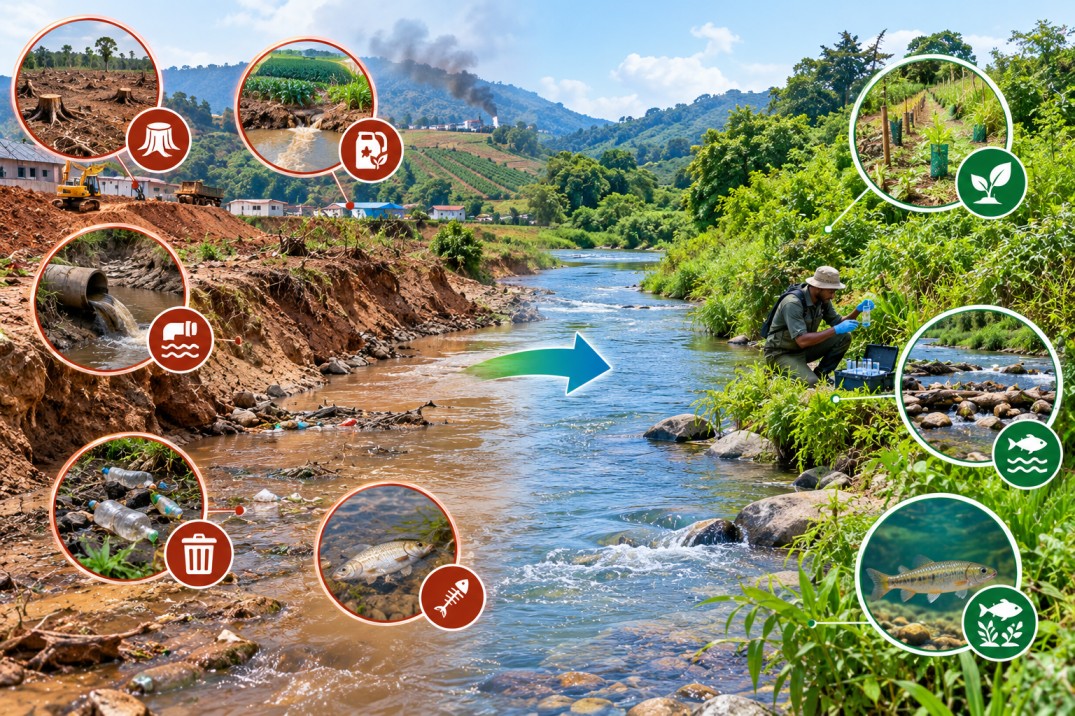
The Okame river in Tiira, Busia district was an important source of water for different uses to the people living around it. However, because of the gold mining activities, the current status of the river is very critical from environmental, and commercial usage point of view. Henceforth, this research work focused on assessing the current situation using different scenarios such as climate change. Water Evaluation and Planning (WEAP), a numerical simulation tool, was used to model river water quality using scenarios viz. business as usual (BAU) and scenario with mitigation measures. |
|
With the prevalent flooding within Kasese Municipality as a result of River Nyamwamba bursting its banks in every rainy season currently, a number of hydrological studies have been conducted. However, the suggested mitigations had not improved the situation because the suffering communities had been left out during solution generation. This study looked at community involvement from the problem identification to solution implementation as well as addressing the gaps in the policy arrangements as far as flood management is concerned in the region |
|
Threats arising from human activities currently affect freshwater bodies, such as headwater streams, and will continue to threaten them in the future, depriving current and future generations of natural resources and services. Among the headwater streams threatened by pollution arising from human activities in the catchment is the Osia stream in Tororo, eastern Uganda. |
|
Through the President's Ministry of Science, Technology and Innovation Office, the Government of Uganda has championed the development of the domestic automotive value chain for job and wealth creation through the commercialization of electric vehicles under Kiira Motors Corporation (KMC). Other private companies, such as Uganda Zembo electric motorcycles and Bodawerk electric motorcycles, are involved in assembling and selling electric motorcycles. |